AGM vs EFB Car Batteries: Which Does Your Start-Stop Car Need?
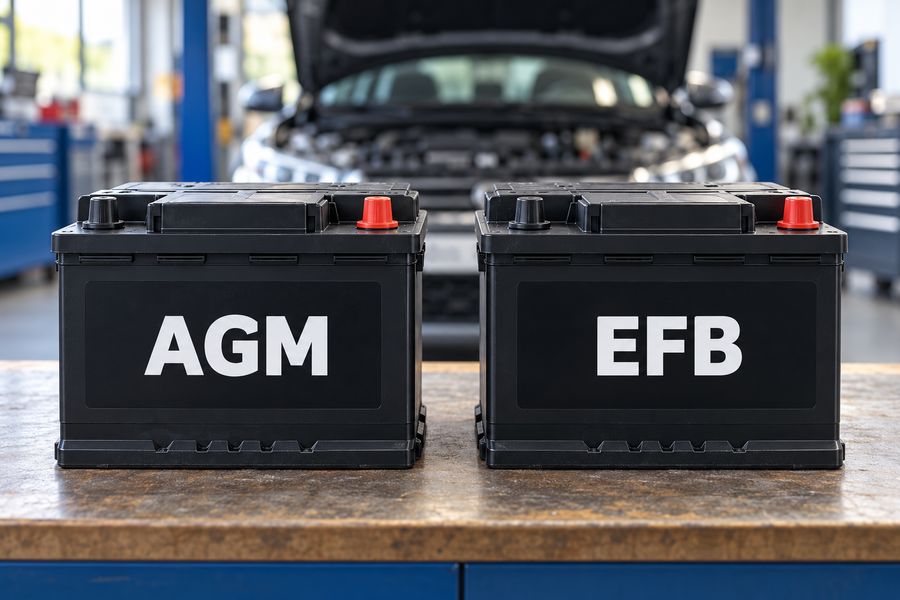
Two car batteries can have the same dimensions, the same 12V rating and similar numbers on their labels, yet still be different replacements. The detail that often decides the choice is the battery technology: AGM or EFB.
If you are comparing car batteries for a start-stop vehicle, this guide explains what those letters mean and gives you a practical checklist to use before ordering.
The quick answer: which battery does your car need?
- If the vehicle requires AGM, fit AGM. Do not downgrade to EFB or a conventional flooded battery.
- If the vehicle requires EFB, a correctly specified EFB is a suitable replacement. An AGM upgrade may be an option, but confirm the application and any changes needed to the vehicle's battery settings.
- If you do not know the required technology, check the vehicle specification before buying. The battery currently fitted is useful evidence, but a previous owner may have installed the wrong one.
Start with our vehicle battery search, then compare the suggested replacement with the vehicle requirements and your existing battery details. Resolve any mismatch before ordering.
What is an EFB car battery?
EFB stands for Enhanced Flooded Battery. It is a development of the conventional flooded lead-acid battery, designed to cope better with repeated charging and discharging.
EFB batteries are used in many vehicles with simpler start-stop systems. They can also suit certain conventional vehicles with demanding usage patterns. The correct choice depends on the application, rather than whether the car looks basic or has lots of optional extras.
What is an AGM car battery?
AGM stands for Absorbent Glass Mat. The electrolyte is held within absorbent glass mat separators rather than remaining as free liquid in the same way as a flooded battery.
Automotive AGM batteries are designed for demanding electrical applications, including many start-stop systems with regenerative braking. They support repeated engine restarts and electrical consumers during engine-off periods.
Both AGM and EFB automotive batteries are lead-acid technologies. AGM is not another name for lithium, and an AGM leisure battery is not automatically a suitable replacement for an AGM starter battery.
AGM vs EFB: the differences that matter when buying
| Buying question | EFB | AGM |
|---|
| What does it mean? |
Enhanced Flooded Battery |
Absorbent Glass Mat |
| Where is it commonly used? |
Many simpler start-stop applications |
Many demanding start-stop and regenerative-braking applications |
| Can it replace a required AGM? |
No |
Yes, with the correct vehicle specification |
| Is physical size enough to choose it? |
No; technology and specification also matter |
No; technology and specification also matter |
The battery-label checklist: what to photograph before ordering
A clear photograph of the label is a useful starting point when asking for help. Add the vehicle registration and details, then work through these checks:
- Technology: look for AGM or EFB. If neither is visible, check the model number against the manufacturer's information rather than guessing from the case colour.
- Capacity: record the Ah figure. This is separate from the starting-current rating.
- Starting current: record the CCA figure and its stated test standard, such as EN or SAE, so comparisons are meaningful.
- Dimensions: compare length, width and total height, including terminals.
- Connections: confirm terminal type, positive-terminal position and cable reach.
- Installation: check the hold-down arrangement and any required vent connection.
For example, two listings might both say 12V and 70Ah. Those matching figures do not establish compatibility if one is AGM and the other is EFB, or if the terminal layout differs.
Keep a simple note with your enquiry: vehicle details, battery model, technology, Ah, CCA and dimensions. It is much easier to resolve uncertainty with these details than with “it looks about the same size”.
Can you replace EFB with AGM?
An EFB-to-AGM upgrade can be appropriate for some applications. However, choose an approved replacement for the vehicle and establish whether its battery-management settings need changing.
If your existing EFB meets the vehicle specification, replacing it with another correctly specified EFB is a valid option. Do not assume paying more for AGM will fix an unrelated charging fault or excessive background drain.
Can you fit a normal battery if you switch start-stop off?
Switching off start-stop does not change the vehicle's battery specification or charging-system design. A conventional flooded battery should not be used to downgrade an application that requires AGM or EFB.
Choose the battery for the vehicle's requirements, even if you rarely use its start-stop feature. Our start-stop battery range includes AGM and EFB options; check the individual application before choosing.
Does an AGM or EFB replacement need registration?
Some vehicles need battery registration, a battery-monitoring reset or coding after replacement. Others use a different procedure. The requirement depends on the vehicle, not simply the letters AGM or EFB.
Registration informs the relevant system that a new battery has been installed. Coding may also be required when an approved replacement changes the battery technology or capacity. Follow the manufacturer's procedure and arrange a suitably equipped installer where needed.
When comparing replacement costs, ask whether the quote includes the battery, fitting and any required diagnostic work. This gives you a more useful comparison than the battery price alone.
Test the battery before blaming the technology
A flat battery and a worn-out battery are different problems. Repeated poor starting deserves an assessment of battery condition and the vehicle's charging system, rather than an automatic technology upgrade.
Our guide to testing a car battery explains the checks in more detail. An appropriate tester should be configured for the battery technology and rating being assessed.
If your battery repeatedly loses charge, read why your car battery keeps going flat for checks covering short journeys, electrical drain and charging problems.
Frequently asked questions
Is AGM always better than EFB?
AGM is designed for demanding applications, but suitability comes first. A correctly specified EFB can be the right replacement for an EFB-equipped vehicle. Choose an approved fitment rather than treating the technologies as interchangeable price options.
Do all start-stop cars use AGM?
No. Many use EFB, while others require AGM. Check the exact vehicle application rather than relying on the presence of a start-stop button.
Can I choose by Ah and CCA alone?
No. You also need the correct technology, case dimensions, terminal arrangement, mounting and any ventilation requirements. Matching two numbers is only part of the selection process.
Find the correct replacement car battery
The useful question is not simply “AGM or EFB?” It is “Which technology and specification does this vehicle require?”
Browse our car battery range, use the vehicle search and check the installation requirements before ordering. If the label or suggested fitment leaves you unsure, call Battery2U on 0151 933 4848 with your vehicle details and existing battery information.