What Size Leisure Battery Do I Need? A Caravan & Motorhome Power Planner
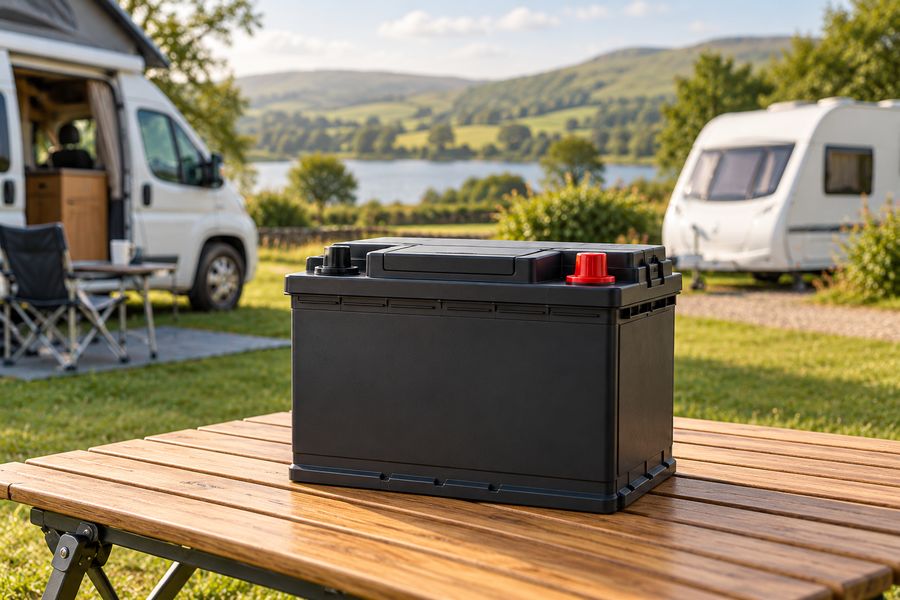
A leisure battery can look perfectly adequate on Friday afternoon and feel much too small by Saturday morning. The difference might be a fridge running through the night, a heating fan working harder than expected, or simply more hours between charges.
When choosing a replacement, ask two questions: how much electricity will you use before the next reliable charge, and will the battery physically fit your vehicle? The amp-hour figure on the label answers only part of the problem.
This guide helps you plan the capacity you need before browsing our leisure batteries for caravans, motorhomes and campervans. All figures in the worked examples are illustrative planning assumptions, not product tests or guaranteed running times.
Start with the gap between charges
Write down when you can realistically recharge: at a campsite, during a journey with a suitable charging system, or from solar. A weekend away does not necessarily mean two days running entirely from the battery. Equally, driving to a campsite does not guarantee a full battery when you arrive.
For your first calculation, leave uncertain solar generation out. You can add measured charging performance later. A plan that relies on sunshine every day leaves little room for a shaded pitch or a wet weekend.
How to calculate your daily battery use
For equipment drawing directly from a 12V system, a useful starting point is:
Current in amps × hours used = amp-hours consumed.
A device drawing 2A for five hours uses approximately 10Ah. If only watts are available, dividing watts by 12 gives a rough current estimate for a nominal 12V system. Actual voltage and conversion losses affect the result. For appliances powered through an inverter, include its losses and standby consumption.
Use appliance specifications or measurements rather than guessing from the name of the appliance. A fridge's daily energy consumption is more useful than assuming it draws its maximum current for all 24 hours.
Example: an evening in a caravan without hook-up
This example assumes cooking and refrigeration do not draw substantial power from the leisure battery. It includes only the electrical loads listed below.
Illustrative daily consumption for a modest 12V setup
| Equipment | Assumed current | Total operating time | Consumption |
|---|
| LED lighting, combined |
1A |
5 hours |
5Ah |
| Television |
2A |
2 hours |
4Ah |
| Heating fan and controls |
2A |
4 hours |
8Ah |
| Water pump |
4A |
15 minutes |
1Ah |
| Phone charging, at battery input |
1A |
2 hours |
2Ah |
| Background electronics |
0.25A |
24 hours |
6Ah |
| Daily total |
— |
— |
26Ah |
|---|
The background load is easy to miss: a small current becomes significant when it runs all day. Over two days with no recharge, this example needs 52Ah. Adding an illustrative 20% reserve gives a planning requirement of about 62Ah of usable capacity.
Why a 110Ah battery does not give you 110Ah to spend routinely
Rated capacity and planned usable capacity are different. For many lead-acid leisure applications, budgeting around 50% of the rated capacity is a conservative starting point intended to limit deep cycling. Follow the particular battery manufacturer's guidance; 50% is not a universal cut-off or a promise of battery life.
Under that assumption, a new, fully charged 110Ah battery offers about 55Ah for the plan. Our two-day caravan example needs roughly 62Ah including reserve, so 110Ah would fall short of that chosen allowance. A 130Ah battery gives about 65Ah under the same assumption, but this is still a calculation rather than a guaranteed recommendation.
Age, temperature, discharge rate and initial state of charge can reduce what is available. Capacity ratings are specified under particular test conditions. A large load can reduce the effective capacity of a lead-acid battery, so simple amp-hour arithmetic is less reliable for demanding inverter use.
The same 110Ah battery in a campervan with a compressor fridge
Now take the same 26Ah daily budget and add a hypothetical compressor fridge consuming 300Wh per day. At a nominal 12V, that represents approximately 25Ah. The new total is about 51Ah per day.
With a 20% reserve, even one day now calls for roughly 61Ah of usable capacity. Two days call for around 122Ah. A 110Ah lead-acid battery planned at 50% discharge cannot cover that two-day requirement.
This explains why advice from another owner can be misleading. Their 110Ah battery may comfortably cover lights and a pump between campsite charges, while your fridge changes the calculation completely. Check your own fridge's daily consumption; the 300Wh figure here is an example, not a typical specification for every model.
Motor movers need a separate check
A motor mover is used briefly but can demand substantial current. Meeting your daily amp-hour budget does not automatically mean the battery is suitable for the mover.
Check the mover manufacturer's battery requirements, including recommended capacity and discharge capability. Where a battery has an NCC verification rating, check the exact model's classification and intended use. Our caravan battery range is a starting point for comparing options; confirm suitability for your equipment before choosing.
Can you solve the problem with a bigger battery?
Sometimes, but first establish whether you are running out of storage or failing to recharge it. A larger battery that repeatedly starts a trip partly charged can still disappoint.
Before ordering, check:
- Dimensions: measure length, width and total height, including terminals and clearance above them.
- Connections: confirm terminal type, polarity and whether the existing cables reach.
- Mounting and ventilation: follow the vehicle and battery instructions for restraint, orientation and vent connections.
- Weight: include the replacement in your vehicle's payload allowance.
- Charging: confirm that the mains charger, solar controller and vehicle charging arrangement support the chosen battery technology.
- Recharge time: allow enough time to restore what you use between trips.
If changing technology, check charging compatibility before buying. Our leisure battery guide explains the main options, and you can compare our leisure battery chargers alongside the replacement.
A five-line plan to make before you buy
- My measured or estimated daily consumption is: ___ Ah.
- The longest planned gap without reliable charging is: ___ days.
- My allowance for extra use and uncertainty is: ___ Ah.
- My chosen battery's planned usable capacity is: ___ Ah, following its manufacturer's guidance.
- My available battery space is: ___ length × ___ width × ___ height.
If you cannot fill in the first line, measuring a day's consumption is a useful next step. If you cannot fill in the last line, measure the compartment before shopping by capacity.
Common leisure battery sizing questions
Is a 110Ah leisure battery enough for a weekend?
It depends on consumption and charging. In our modest caravan example, two days consume 52Ah before reserve. In the fridge example, two days consume 102Ah before reserve. The same label capacity cannot promise the same weekend running time for both vehicles.
Should I replace my battery with the same amp-hour rating?
That can be sensible if the existing setup met your needs and the replacement matches the vehicle's requirements. If equipment or camping habits have changed, recalculate the demand and check fitment before choosing a different capacity.
Will an AGM battery always last longer between charges?
Do not assume that AGM alone guarantees more running time. Compare the specific battery's capacity, permitted discharge, discharge performance and charging requirements. A technology label cannot replace a power budget.
Choose your leisure battery around the trip you actually take
The useful question is not simply which battery has the biggest number. It is whether its usable capacity covers your equipment until the next dependable charge, while meeting your vehicle's installation requirements.
Browse Battery2U's leisure battery range to compare capacities and specifications. For help narrowing the choice, call 0151 933 4646 with your existing battery details, compartment measurements, charging equipment and a list of the appliances you want to run.